

Tape-In Hair Extensions
Ann Arbor, MI
Seamless length and fullness begin with the right method, precise color matching and an installation designed around your natural hair—not a one-size-fits-all package.
Beautiful Tape-Ins Start With the Right Recommendation
Beautiful hair extensions are not determined by the popularity of an application method. They are determined by choosing the method your natural hair can support—and then executing the color match, placement, density and haircut with precision.
Many guests arrive at Avissa Salon already asking for tape-in hair extensions. Sometimes tape-ins are exactly what we recommend. Other times, nano bead extensions or hand-tied wefts provide a better balance of comfort, styling freedom and long-term wear. Our role is not to sell the same method to every guest. It is to identify the safest, most convincing path to the result you want.
Tape-ins can create exceptional length, fullness and color dimension when the natural hair, lifestyle and maintenance schedule are a good match. They lie close to the scalp, distribute weight across a wider attachment and can be customized with different widths, shades and placement patterns. The finished result should move like your own hair and disappear into your haircut—not look like a separate layer added underneath it.
Your consultation is where that result begins. We evaluate your hair density, texture, scalp condition, current haircut, hair color, styling routine and previous extension history before recommending a plan.
What Are Tape-In Hair Extensions?
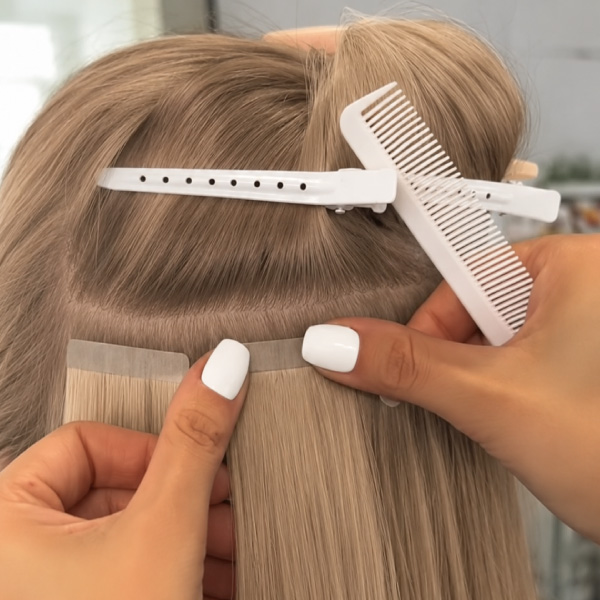
Tape-in extensions are thin sections of human hair attached to flat adhesive panels. During installation, a carefully sized section of natural hair is placed between compatible tape panels, creating a lightweight attachment that rests close to the scalp.
The flat profile is the defining advantage of the method. When placement is planned around the guest’s density and preferred hairstyles, tape-ins can be discreet, comfortable and efficient to install. They can add overall length, reinforce fragile-looking ends, fill sparse areas through the sides, or create color dimension without repeatedly lightening the natural hair.
Tape-ins are semi-permanent. They are worn continuously and must be professionally removed and repositioned as the natural hair grows. The extension hair may be reused when its condition and the manufacturer’s system allow it, but the adhesive is replaced during reapplication.
Specialist perspective:
The attachment method is only one part of the service. The most believable results depend on matching density from roots to ends, distributing weight responsibly, preserving enough natural hair to conceal the panels, and blending the final shape with a customized haircut.
Who Is Often a Strong Candidate for Tape-Ins?
Tape-ins are frequently a strong option for guests with fine to medium-density hair who want fuller ends, added length or targeted volume without the bulk of a larger weft track.
They can also work well for first-time extension wearers because the panels are flat, the installation is comparatively efficient, and the method can be customized gradually. A guest may begin with a modest amount of hair for fullness before committing to a longer or denser transformation.
Tape-ins may be especially useful when the goal is to add strategic brightness or lowlights while reducing how often the natural hair must be lightened. Extension color can support a balayage, highlights or dimensional hair color plan, but it must still be matched and placed by a professional so the result looks intentional rather than striped.
Tape-Ins May Be a Strong Fit When you:
| • | Have fine to medium-density hair with enough coverage to conceal flat panels. |
| • | Want length, fuller ends or volume through the sides. |
| • | Prefer a flat attachment that sits close to the scalp. |
| • | Are comfortable returning for scheduled maintenance. |
| • | Are willing to keep oils and heavy conditioners away from the adhesive area. |
| • | Want a method that can integrate with professional hair color and a customized haircut. |
When We May Recommend Another Method
No extension method is ideal for every guest. If the natural hair is too fragile, actively shedding, severely compromised or unable to conceal an attachment safely, the responsible recommendation may be to postpone extensions and focus first on hair and scalp health.
A different application may also be better for a guest who wears very high ponytails daily, has limited coverage around the sides, produces significant scalp oil, swims frequently, or prefers an adhesive-free method. Guests seeking maximum density on naturally thick hair may prefer hand-tied wefts, while some active guests prefer the individual movement of nano bead extensions.
The correct recommendation is the one that creates the best result without asking your natural hair or lifestyle to accommodate an unsuitable system.
We may recommend Hand-Tied Wefts if:
✔ You have naturally thick hair
✔ You want maximum density
✔ You prefer fewer extension panels
We may recommend Nano Bead Extensions if:
✔ You wear high ponytails regularly
✔ You exercise frequently
✔ You have an oily scalp
✔ You prefer an adhesive-free method
Choosing the right extension method is often more important than choosing the most popular one.
| Advantages of Tape-In Extensions | Limitations of Tape-In Extensions |
| Flat, discreet attachment The panels rest close to the scalp and can be concealed well when the guest has appropriate density and the placement is customized. |
Adhesive requires disciplined aftercare Oil, heavy conditioner, sunscreen, certain product residue and insufficient drying near the tabs can weaken adhesion. |
| Efficient installation Tape-ins usually require less installation time than a full head of individual strand extensions. |
Maintenance cannot be postponed indefinitely As the hair grows, the panels move away from the scalp. Delayed maintenance can increase tangling, visibility and stress on the natural hair. |
| Weight distribution The attachment spreads weight across a wider section rather than concentrating it at one small point. |
Placement affects hairstyle freedom Poorly planned panels may show in high ponytails, very fine side sections or tightly pulled styles. |
| Flexible customization Different widths, shades and placement patterns can be combined for length, volume, correction of thin ends or dimensional color. |
Removal must be professional Pulling, peeling or dissolving the adhesive incorrectly can damage the natural hair and compromise the extension hair. |
| Potential for reuse Quality extension hair can often be cleaned, re-taped and reapplied when it remains in good condition and is compatible with the selected system. |
Not appropriate for every density Extremely fine, fragile or sparse hair may not provide enough strength or coverage for a traditional tape sandwich. |
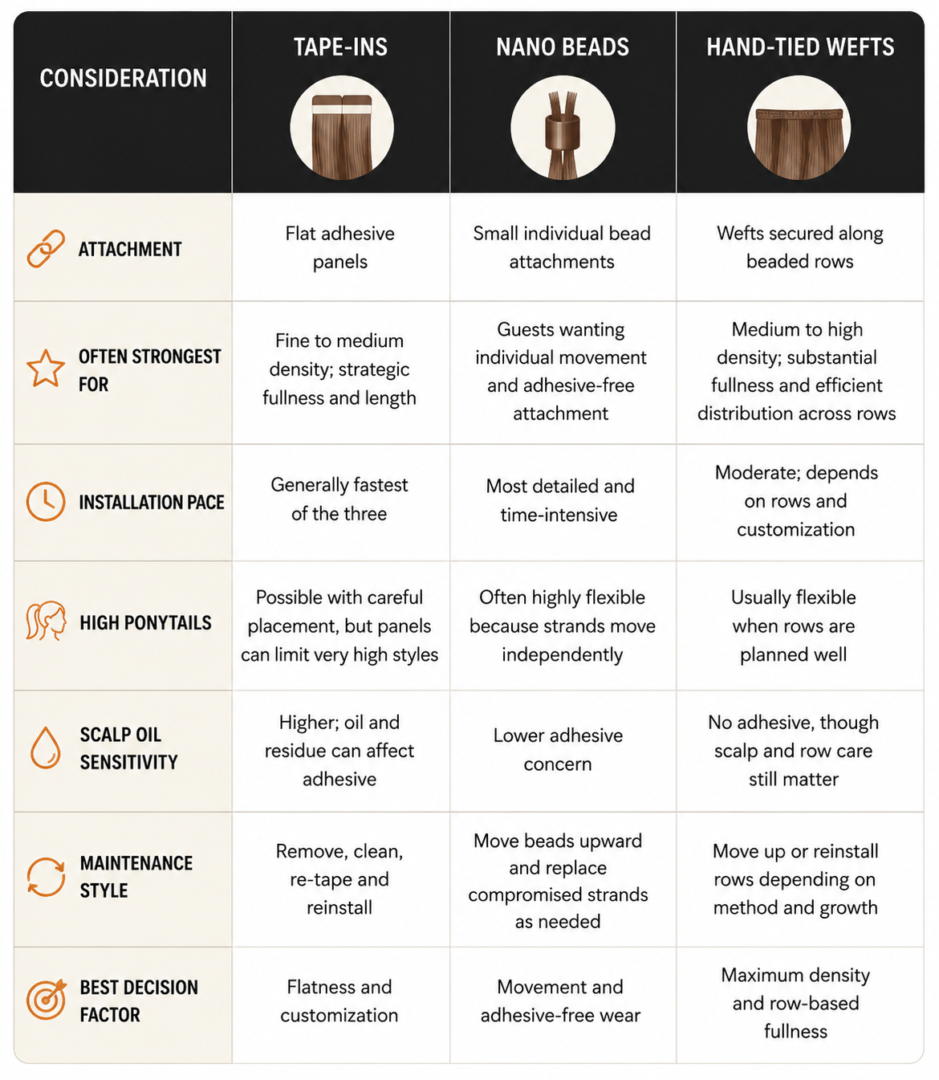
Tape-Ins vs. Nano Beads vs. Hand-Tied Wefts
The best method depends on natural density, desired fullness, attachment visibility, styling habits and maintenance preferences. The table below is a consultation guide—not a substitute for examining the hair in person.
Explore: Hand-Tied Weft Hair Extensions →
Explore: Nano Bead Weft Hair Extensions →
Why Hair Color Is Part of the Extension Service
One of the most overlooked parts of a successful extension installation is the hair color plan. An excellent application can still look obvious if the extension shades do not reflect the natural hair’s depth, warmth, brightness and dimensional pattern.
At Avissa Salon, color matching is not limited to choosing one shade from a ring. We consider the root area, mids, ends, face frame and how the hair changes in different lighting. Many transformations require a blend of shades rather than one flat color.
When appropriate, we may coordinate the extension service with hair color, balayage, highlights, gray coverage or a toner and gloss. The goal is not necessarily to color the extension hair after installation. It is to build the color strategy before the hair is ordered and installed so the blend remains natural as the guest moves and styles it.
Extension hair should not be casually lightened. Significant color changes, bleaching or chemical correction can compromise extension hair and may not produce the same predictable result as coloring natural hair. Any toning or darkening should be evaluated and performed professionally.
Why the Haircut Determines Whether Extensions Look Natural
The final haircut is not an optional finishing touch. It is a structural part of the extension service.
Natural hair that ends in a blunt, heavy line can sit visibly over longer extension hair. Short layers may separate from the added length. Too much density in the wrong area can create a shelf, while too little density through the ends can make the transformation look thin and disconnected.
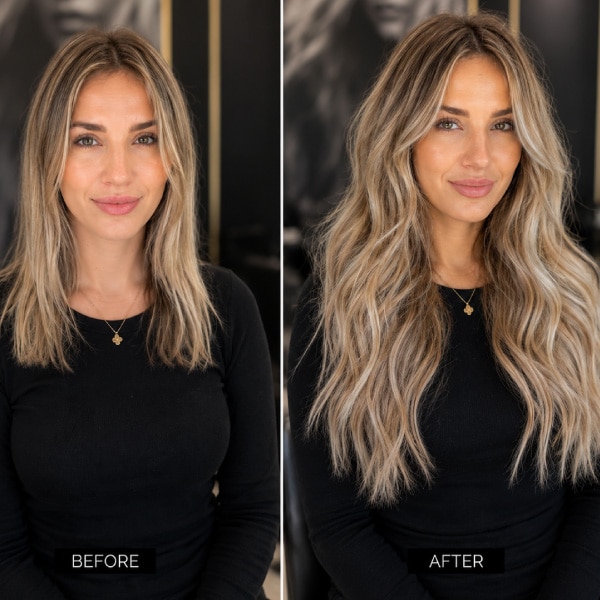
After installation, we evaluate the silhouette from every angle and customize the haircut to blend the natural hair with the extensions. That may include softening a perimeter, creating movement, connecting layers, balancing the face frame or removing carefully selected weight. The objective is not to thin out the extensions indiscriminately. It is to make the combined hair behave as one shape.
Guests who maintain a precise haircut between extension appointments generally achieve a more polished result than guests who treat extensions as an attachment-only service.
Our Consultation and Installation Process
1. Hair and scalp assessment — We evaluate density, strand strength, scalp condition, shedding, breakage, previous chemical services and whether the natural hair can support the desired transformation.
2. Lifestyle and styling review — We discuss ponytails, workouts, swimming, work requirements, preferred parting, frequency of washing and willingness to return for maintenance.
3. Method recommendation — We compare tape-ins with nano beads and hand-tied wefts when relevant. The recommendation may include one method or a hybrid approach.
4. Color and density plan — We select shades, lengths, texture and the amount of hair needed to create a believable transition from roots to ends.
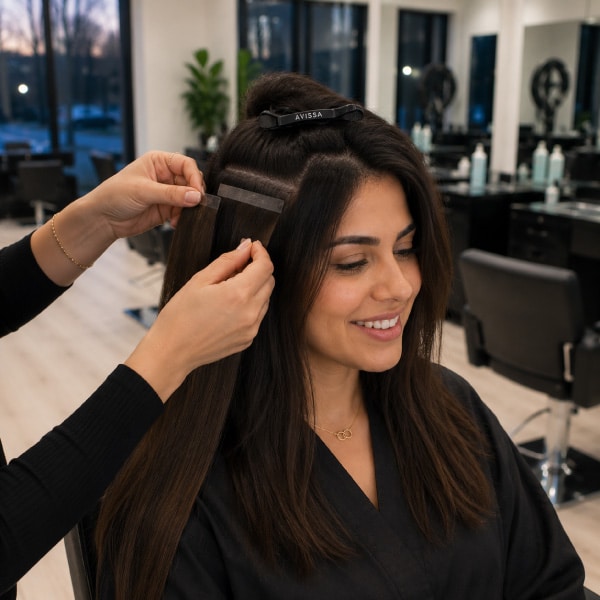
5. Customized placement — Panels are positioned to protect concealment, movement, comfort and the hairstyles the guest wears most often.
6. Blending haircut and finish — The natural hair and extension hair are shaped together. We style the finished result and review what should—and should not—be done at home.
7. Maintenance roadmap — Before you leave, you should understand your return interval, home-care routine, product restrictions and signs that require an earlier appointment.
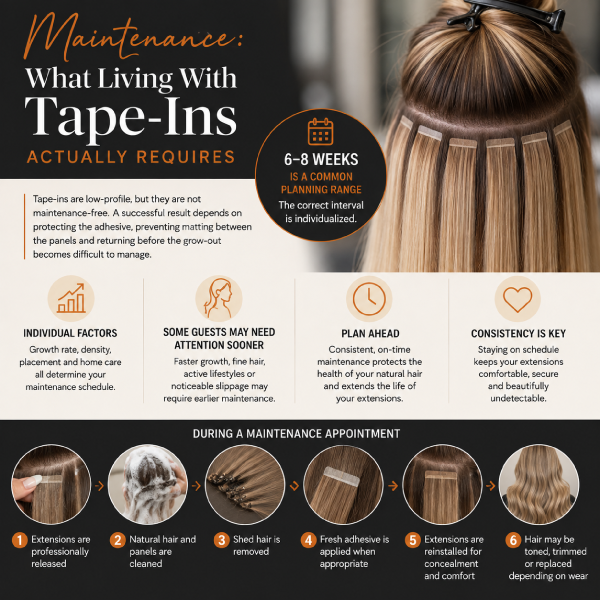
Maintenance: What Living With Tape-Ins Actually Requires
Tape-ins are low-profile, but they are not maintenance-free. A successful result depends on protecting the adhesive, preventing matting between the panels and returning before the grow-out becomes difficult to manage.
Most guests need professional maintenance on a repeating schedule determined by growth rate, density, placement and home care. Six to eight weeks is a common planning range, but the correct interval is individualized. Guests with faster growth, fine hair, active lifestyles or noticeable slippage may need attention sooner.
During a maintenance appointment, the extensions are professionally released, the natural hair and panels are cleaned, shed hair is removed, fresh adhesive is applied when appropriate, and the extensions are reinstalled in a position that restores concealment and comfort. The hair may also need toning, trimming or replacement depending on wear.
Daily and weekly habits that protect the result:
| • | Brush gently from the ends upward while supporting the attachment area |
| • | Separate the panels regularly so neighboring sections do not mat together |
| • | Wash the scalp thoroughly without aggressively rubbing the tabs against one another |
| • | Apply conditioner and oils through the mids and ends, not directly on the adhesive |
| • | Dry the roots and attachment area completely before sleeping |
| • | Wear the hair in a loose braid or low ponytail at night |
| • | Use heat protection and keep very hot tools away from the adhesive panels |
| • | Schedule maintenance before the extensions become tangled, visible or uncomfortable |
Working Out, Swimming and Michigan Weather
An active lifestyle does not automatically rule out tape-ins, but it does make placement and aftercare more important. Sweat, scalp oil and frequent washing can shorten adhesive performance for some guests. The attachment area should be dried after workouts rather than left damp for long periods.
Before swimming, detangle the hair, secure it in a braid and follow the care instructions provided for your extension brand. Chlorine, minerals, saltwater and sunscreen can affect extension hair, color and adhesive. Rinse promptly after swimming and avoid allowing sunscreen or oily products to sit on the panels.
Michigan’s seasonal changes also matter. Indoor heat can leave long extension hair dry in winter, while summer humidity can increase tangling and styling demands. Professional products, consistent brushing and moisture through the lengths help preserve movement without coating the tape area.
How Long Do Tape-In Extensions Last?
There are two different timelines: how long one installation remains in position, and how long the extension hair itself remains suitable for reuse.
The installation must be repositioned as the natural hair grows. The extension hair may last through multiple applications when it is high quality, maintained correctly and not excessively damaged by heat, chemicals, hard water or improper brushing. There is no responsible universal promise of a fixed number of months because lifestyle, hair quality and home care vary significantly.
We evaluate the hair at each maintenance visit. Reusing extension hair that has become dry, thin, tangled or structurally compromised may save money temporarily but usually weakens the finished result. Replacement should be based on condition—not only age.
Common Mistakes That Shorten Wear or Cause Damage
| • | Waiting too long between maintenance appointments |
| • | Placing oil, masks, heavy conditioner or sunscreen near the adhesive |
| • | Sleeping with wet hair or leaving the attachment area damp |
| • | Pulling through tangles without supporting the panels |
| • | Using excessive heat directly on the adhesive |
| • | Attempting at-home removal |
| • | Installing too much hair for the natural density |
| • | Failing to blend the finished installation with a professional haircut |
| • | Treating extension hair like it can tolerate unlimited bleach or chemical correction |
When Tape-Ins Should Be Removed Early
Contact the salon rather than waiting for the next scheduled appointment if you experience unusual pulling, persistent scalp discomfort, rapid slippage, visible matting, a panel folding over, or an attachment hanging from a very small amount of natural hair.
Early evaluation can prevent a minor maintenance issue from becoming a removal or breakage problem. Extensions should feel secure and present, but they should not cause ongoing pain.
Not Sure Which Hair Extension Method Is Right For You?
Choosing the right hair extension method depends on several factors, including your natural hair density, desired length and volume, lifestyle, styling routine, and maintenance preferences. While each extension system offers beautiful, natural-looking results, some methods are better suited to certain hair types than others.
During your personalized consultation, we’ll evaluate your hair and recommend the option that best supports your goals while protecting the health of your natural hair.
Frequently Asked Questions (Tape-In Hair Extensions)
Are tape-in extensions good for fine hair?
They can be an excellent option for many guests with fine or medium-density hair because the attachment lies flat and distributes weight across a wider area. However, the natural hair must still be strong enough to support the panels and dense enough to conceal them. Very fragile or sparse hair may require a modified plan, a different method or postponement.
Will tape-in extensions damage my natural hair?
No extension method is automatically damage-free. When tape-ins are correctly sized, responsibly placed, maintained on schedule and professionally removed, many guests wear them successfully. Damage risk increases with excessive weight, poor placement, delayed maintenance, matting, chemical compromise or at-home removal.
How often do tape-in extensions need maintenance?
Six to eight weeks is a common planning range, but the right interval depends on growth rate, density, placement, slippage and home care. Your stylist may recommend an earlier or different schedule.
Can I wear tape-in extensions in a ponytail?
Yes, when placement is customized around the styles you wear. Very high or tightly pulled ponytails may expose panels on some guests. Bring photos of your typical hairstyles to the consultation so placement can be planned accordingly.
Can I color tape-in extensions?
Professional human-hair extensions may sometimes be toned or darkened, but significant lightening is generally not recommended. The safest strategy is to select and blend the correct shades before installation and coordinate any natural-hair color service with the extension plan.
Can I use hot tools on tape-in extensions?
Quality human-hair extensions can usually be curled or straightened with heat protection. Keep excessive heat away from the adhesive tabs and use the temperature recommended for the condition of the extension hair.
Can I swim with tape-in extensions?
Many guests swim with extensions, but chlorine, saltwater, minerals, sunscreen and prolonged dampness can affect the hair and adhesive. Secure the hair, follow the salon’s preparation instructions, rinse promptly and dry the attachment area thoroughly.
How long does a tape-in installation take?
Appointment length varies with the amount of hair, removal and reapplication needs, color services and the complexity of the blending haircut. Tape-ins are generally faster to install than a full individual-strand application, but a customized transformation should not be rushed.
How much do tape-in hair extensions cost?
Pricing depends on the hair length, amount, shade blend, desired density, installation complexity and whether color or haircut services are included. A consultation is required to provide an accurate plan and investment.
Can tape-in hair be reused?
Often, yes. Reuse depends on the extension system and the condition of the hair. At maintenance, the hair is evaluated, cleaned and re-taped when appropriate. Worn or compromised pieces should be replaced rather than reused solely to reduce cost.
Should I get hair color before or after tape-in extensions?
The color plan should be established before installation. In many cases, the natural hair is colored first and the extensions are selected to match or enhance the finished result. Exact timing depends on the service plan and extension system.
Do tape-in extensions need a special haircut?
They need a customized blending haircut. The natural hair and extension hair must be shaped together so the perimeter, layers and face frame transition smoothly. Without blending, even premium hair can look disconnected.
Why Choose Avissa Salon for Tape-In Hair Extensions?
Avissa Salon approaches extensions as a complete design service—not simply the attachment of additional hair.
Our recommendations account for natural density, current haircut, hair color, lifestyle, maintenance tolerance and the result you want to see months from now—not only on installation day. We explain the tradeoffs between methods, design the color and density plan, customize placement, blend the haircut and provide a maintenance roadmap before you leave.
We will recommend tape-ins when they are the right fit. We will recommend another method—or advise waiting—when that is the more responsible choice. That honesty is essential to protecting your natural hair and creating a result that remains believable between appointments.
Ready to Find the Right Extension Method?
Schedule a professional hair extension consultation at Avissa Salon in Ann Arbor. We will evaluate your natural hair, discuss your color and length goals, compare application methods and create a realistic plan for installation, maintenance and long-term wear.
Related Links & Services
Learn more about Hair Extensions and discover additional services that complement your appointment and help you achieve your beauty goals.