
Nano Bead Hair Extensions
Individual-Strand Extensions . Ann Arbor, MI
Discreet, individually placed extensions designed around your natural density, color, haircut, lifestyle and long-term hair health.
Small Attachments Do Not Automatically Mean a Small Commitment
Nano bead extensions are often promoted as nearly invisible, adhesive-free and suitable for almost anyone. The attachment points can be exceptionally discreet, but the size of the bead is only one part of the design. A successful hair extension installation also depends on how much natural hair supports each strand, the weight and length of the extension hair, placement, tension, color matching, haircut blending, daily care and timely maintenance.
At Avissa Salon, we do not choose nano beads simply because they are small. We choose them when individually controlled placement offers a genuine advantage for the guest’s density, styling habits and desired result. For some guests, nano beads create the most natural movement and the greatest freedom around the sides, crown and hairline. For others, tape-in hair extensions or hand-tied weft hair extensions may distribute weight more appropriately or deliver the requested fullness more efficiently.
The consultation is where that distinction is made. We evaluate density from the scalp through the ends, strand strength, active breakage, scalp condition, current haircut, hair color, preferred hairstyles, workout and swimming habits, maintenance tolerance and previous extension history. We then recommend the least complicated system capable of producing the result safely and convincingly.
Our goal is not to install the maximum number of strands. It is to create a believable result your natural hair can reasonably support.
What Are Nano Bead Hair Extensions?
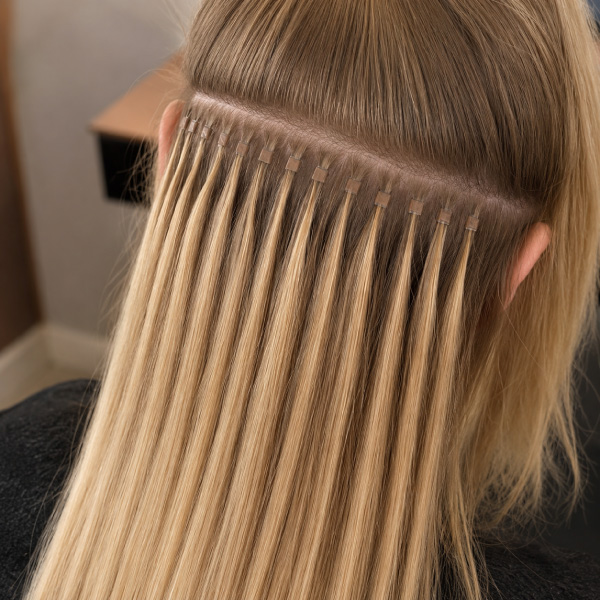
Nano bead extensions are an individual-strand extension method. Small sections of natural hair are threaded through tiny beads, and an extension strand is secured inside each bead. The attachments are placed one by one, allowing the stylist to vary density, direction and spacing across different areas of the head.
The terminology is not perfectly standardized. “Nano bead,” “nano ring,” “nano tip” and “nano link” may be used for related but not identical products. Some systems use extension strands with a fine wire or nano tip inserted into a very small bead. Others use different strand constructions or bead materials. The marketing name alone does not tell you the quality of the hair, whether the bead is silicone-lined, how the attachment is protected, or whether the method is appropriate for your hair.
What defines the guest experience is the complete system: the extension strand, bead, section size, weight, placement pattern and maintenance plan. A tiny bead installed with excessive weight or tension is not automatically gentle. Conversely, a carefully selected strand supported by an appropriate amount of healthy natural hair can provide discreet, flexible wear.
Why Guests Choose Nano Beads
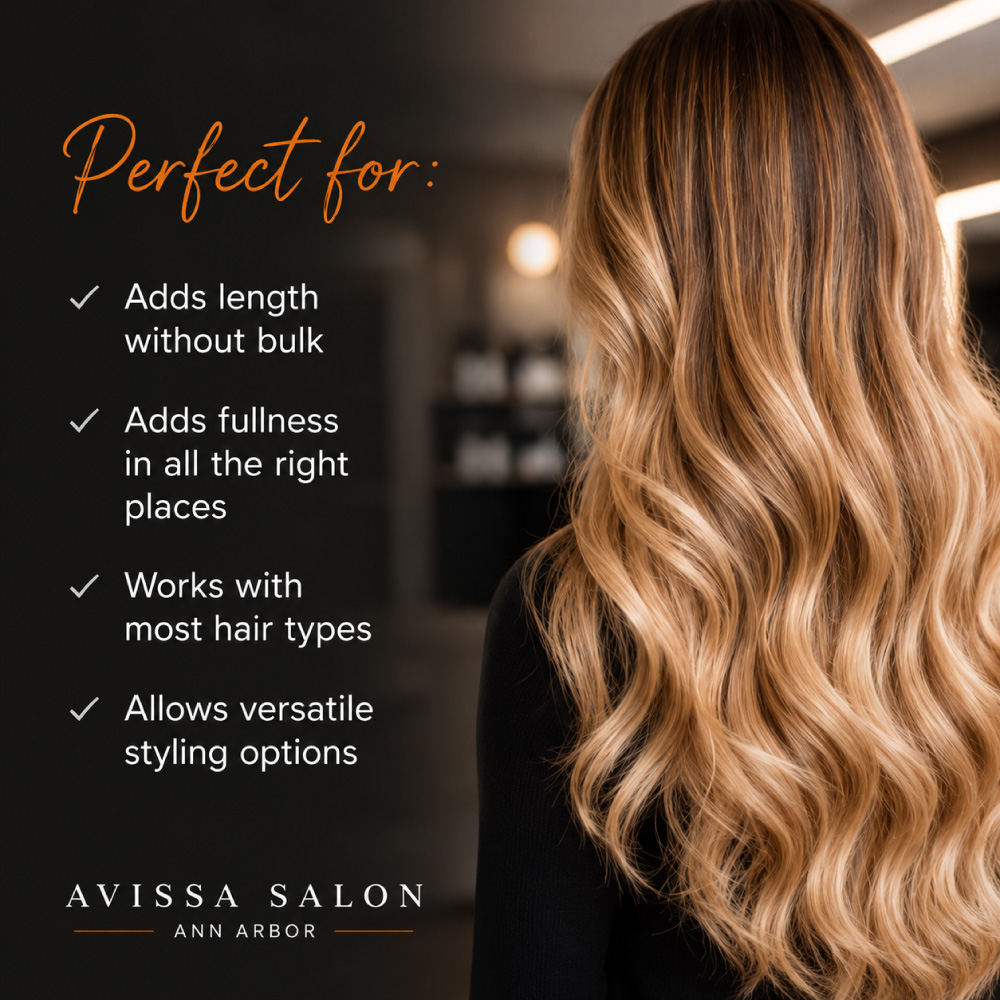
The appeal of nano beads is control. Because the strands are installed individually, density can be built gradually and placement can be adjusted around the guest’s haircut, parting, hairline and preferred styles.
| • | No adhesive is used at the attachment point. |
| • | No bonding heat is required during installation. |
| • | Small attachments can be highly discreet when the natural hair provides sufficient coverage. |
| • | Individual strands move independently and can create natural separation and flow. |
| • | Placement can be customized around the sides, crown, fringe and perimeter. |
| • | Strategic strands can add targeted fullness without installing a full row or large panels. |
| • | The extension hair may be reusable while its condition and attachment tip remain suitable. |
| • | Multiple shades can be combined to support dimensional hair color. |
Nano Bead Extensions May Be a Strong Fit When you:
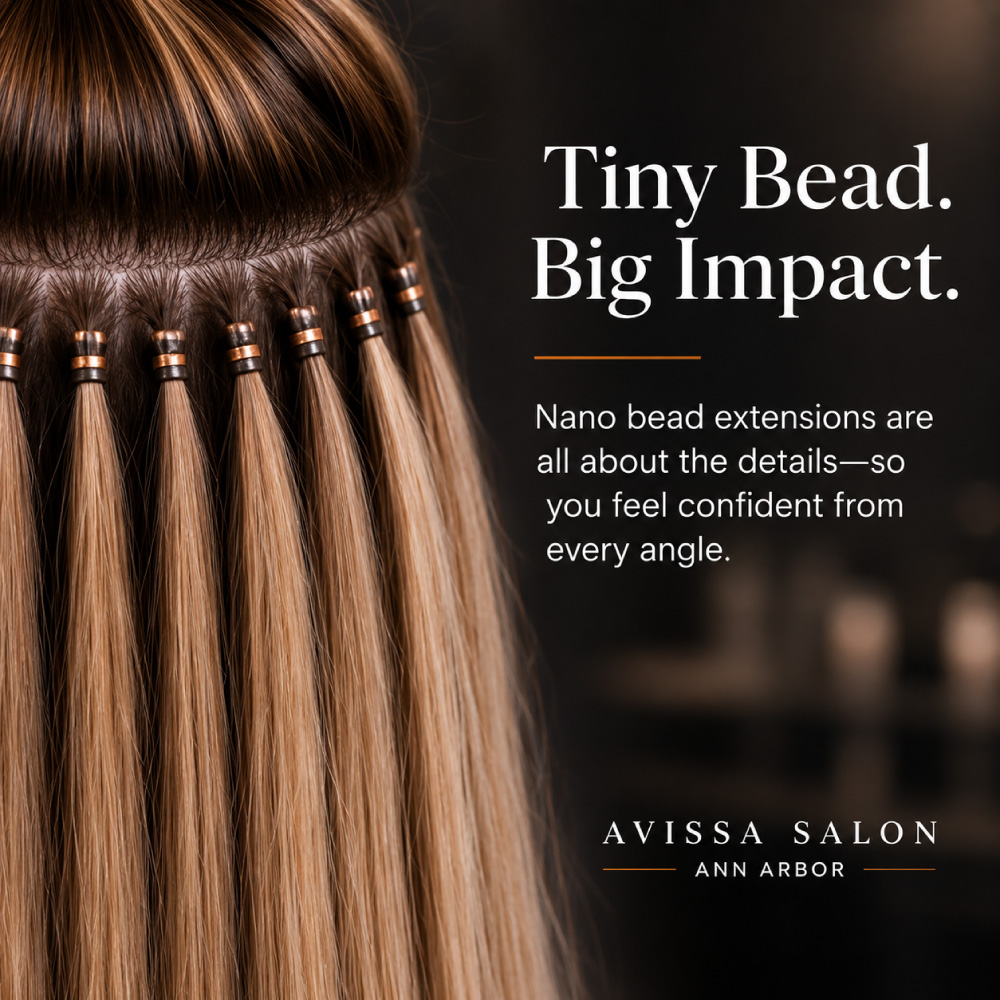
Nano beads can work well for guests with healthy fine-to-medium or medium-density hair who want flexible, individualized placement. They may be especially useful when a guest wants fullness around specific areas, prefers adhesive-free attachments, frequently changes the part, or wears hairstyles that benefit from independent strand movement.
Nano beads may be a strong fit when you:
| • | Have enough healthy natural hair to support and conceal each attachment. |
| • | Want targeted fullness, length or perimeter support rather than one continuous row. |
| • | Prefer an adhesive-free extension method. |
| • | Wear ponytails, braids or upstyles that benefit from individualized placement. |
| • | Want a method that can be customized around layers, sides or a changing part. |
| • | Are comfortable with a detailed installation and scheduled maintenance. |
| • | Will brush carefully, keep the attachment area dry and avoid pulling at the beads. |
| • | Want the extension plan coordinated with professional hair color and a blending haircut. |
When We May Recommend Another Method
Nano beads are not automatically the best choice for very fragile, sparse or actively shedding hair. Each extension strand creates an individual load point. When too much weight is attached to too little natural hair, the result can be discomfort, slippage, breakage or traction-related stress.
We may recommend tape-ins when a flatter panel and broader weight distribution are more appropriate for the guest’s density. Hand-tied wefts may be more efficient for guests with medium-to-thick hair who want substantial fullness or length through the back. A hybrid plan may use more than one method, but only when the added complexity clearly improves the result.
We may advise against or postpone installation when there is active shedding, unexplained hair loss, scalp irritation, significant breakage, very short layers that cannot blend, insufficient density around the proposed attachments, or an inability to maintain the extensions on schedule. A salon consultation cannot diagnose a medical condition; sudden shedding, scalp disease or unexplained loss should be evaluated by an appropriate healthcare professional.
| Advantages of Nano Bead Extensions | Limitations of Nano Bead Extensions |
| Highly customizable placement Individual strands allow the installation to follow the guest’s density, haircut, part and styling habits rather than relying on fixed panels or rows. | Detailed, time-intensive installation
An individualized installation can involve many attachment points and requires precision. It is generally slower than a comparable tape-in service. |
| Discreet attachment points
The beads are very small and can be concealed effectively when placement and natural coverage are appropriate. |
Many points require disciplined care
Each bead must be brushed around, kept separated and monitored. Neglect can allow matting between attachments.needed for a dramatic result. |
| Independent movement
Each strand moves separately, which can create a natural fall and flexibility in ponytails, braids and layered styles. |
Slippage can occur
Oil, very silky hair, incorrect section size, product buildup or improper clamping can contribute to strands slipping. |
| No adhesive or bonding heat
The attachment relies on a mechanically closed bead rather than glue or heat-applied keratin. |
Not appropriate for every fine-hair guest
Small does not mean weightless. Fragile or sparse hair may not safely support the desired quantity or length. |
| Targeted density
The stylist can add more or fewer strands in specific zones to correct asymmetry, support the sides or strengthen the perimeter. |
Beads may be felt or occasionally seen
Poor placement, insufficient coverage, a changing part or very tight styles can expose attachments. |
| Color dimension without coloring every natural strand Multiple extension shades can create brightness, depth or contrast while reducing the need to chemically lighten every section of the natural hair. |
Metal and pressure considerations
Some guests may dislike the tactile feel of beads, and product materials should be considered for guests with known sensitivities. Any painful pressure requires prompt evaluation. |
| Maintenance cannot be postponed indefinitely
As the natural hair grows, attachments move away from the scalp and leverage increases. Delayed maintenance raises the risk of tangling, discomfort and breakage. |
|
| Professional removal is essential
Pulling, twisting or attempting removal at home can damage natural hair and compromise reusable extension strands. |
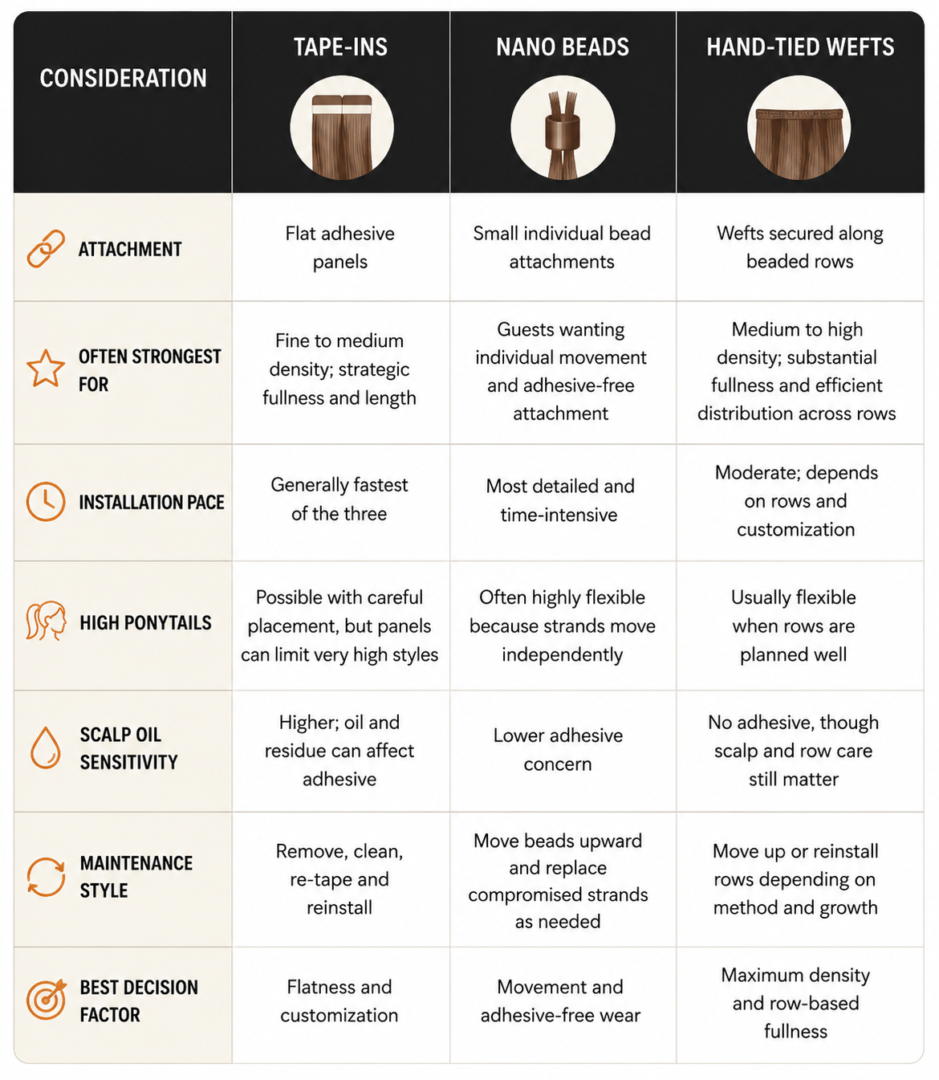
Nano Beads vs. Tape-Ins vs. Hand-Tied Wefts
The best method depends on natural density, attachment visibility, desired fullness, movement, styling habits and maintenance tolerance. This comparison is a consultation guide, not a substitute for examining the hair in person.
Explore: Hand-Tied Weft Hair Extensions →
Explore: Tape-In Hair Extensions →
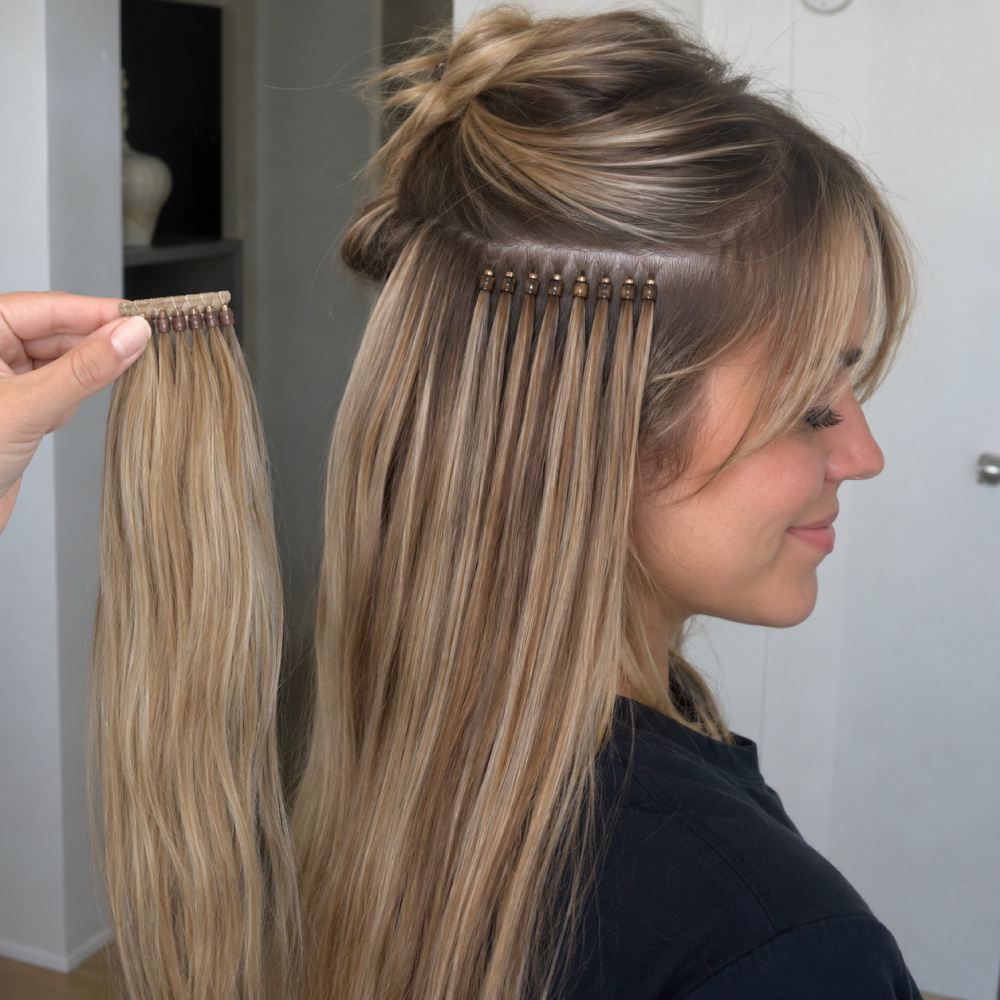
Why Hair Color Is Part of the Nano Bead Design
Nano beads can be discreet at the scalp and still look obvious through the lengths if the color design is incomplete. The extension hair must blend with the root, mids, ends, natural lowlights, face frame and the way the hair shifts in different lighting.
At Avissa Salon, color matching may involve several extension shades rather than one uniform bundle. A blonde result may require a rooted shade, brighter ribbons and softer lowlights. Brunette hair may need multiple depths and temperatures to avoid a flat block of color. Guests maintaining balayage, highlights, gray coverage or a toner and gloss may benefit from coordinating their hair color before installation so the extension strands disappear into the overall design.
Nano bead placement can also be used strategically to reinforce color dimension. Carefully selected brighter or deeper strands can add visual movement without lightening every piece of natural hair. That does not mean extension hair should be treated like untreated natural hair. Aggressive bleaching or major corrective color can compromise the fiber and produce unpredictable results. The preferred approach is accurate shade selection, conservative refinement when appropriate and a coordinated color plan before installation.
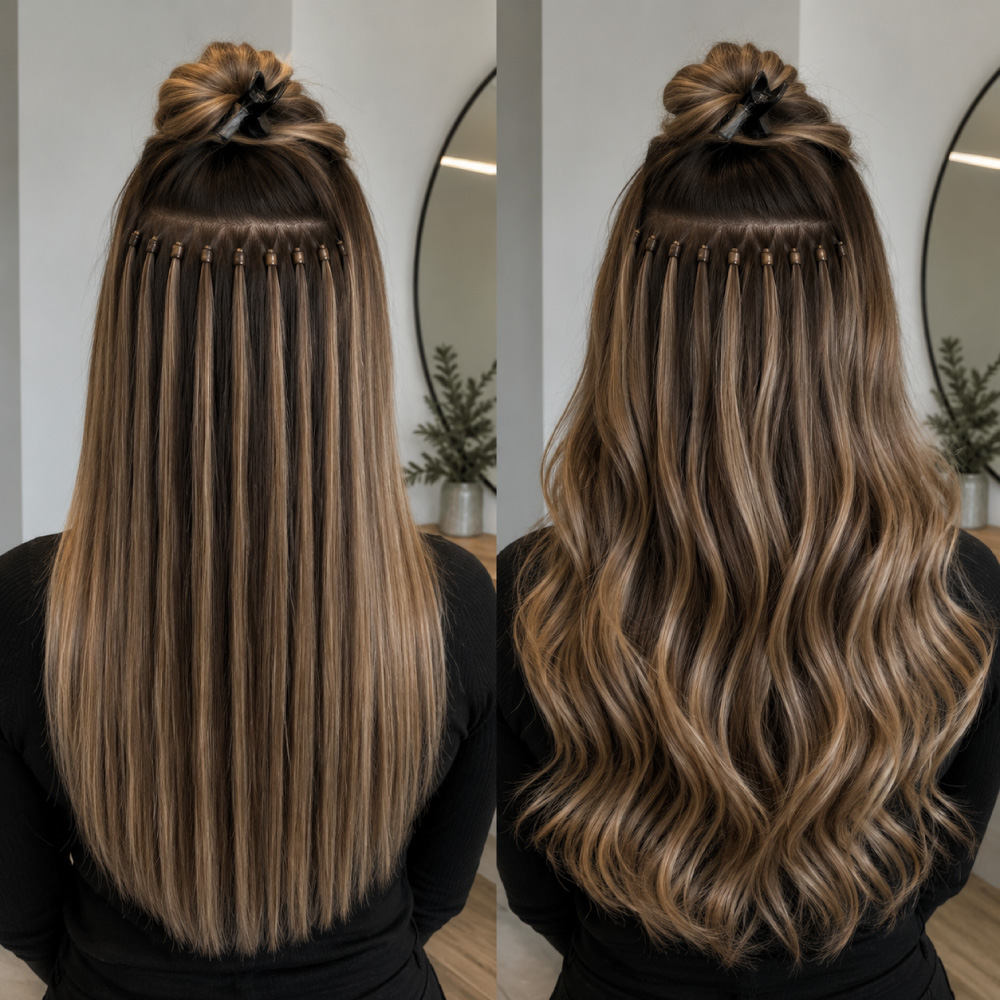
Why the Haircut Determines Whether Individual Strands Blend
Individual attachments create movement, but movement alone does not guarantee a seamless result. The natural haircut and the extension haircut must work as one shape.
A blunt natural perimeter can sit visibly over longer extensions. Short, disconnected layers may create a shelf. Too many extension strands below a lightweight natural top can make the result look bottom-heavy. Placing length without adding appropriate side density can also create a thin or stringy transition.
After installation, we assess the silhouette from every angle and customize the haircut to connect the natural hair with the extensions. That may involve softening the perimeter, building long layers, removing selected bulk, shaping the face frame and balancing the sides. The goal is not to cut away the investment. It is to make the extension hair move as if it belongs to the guest’s natural haircut.
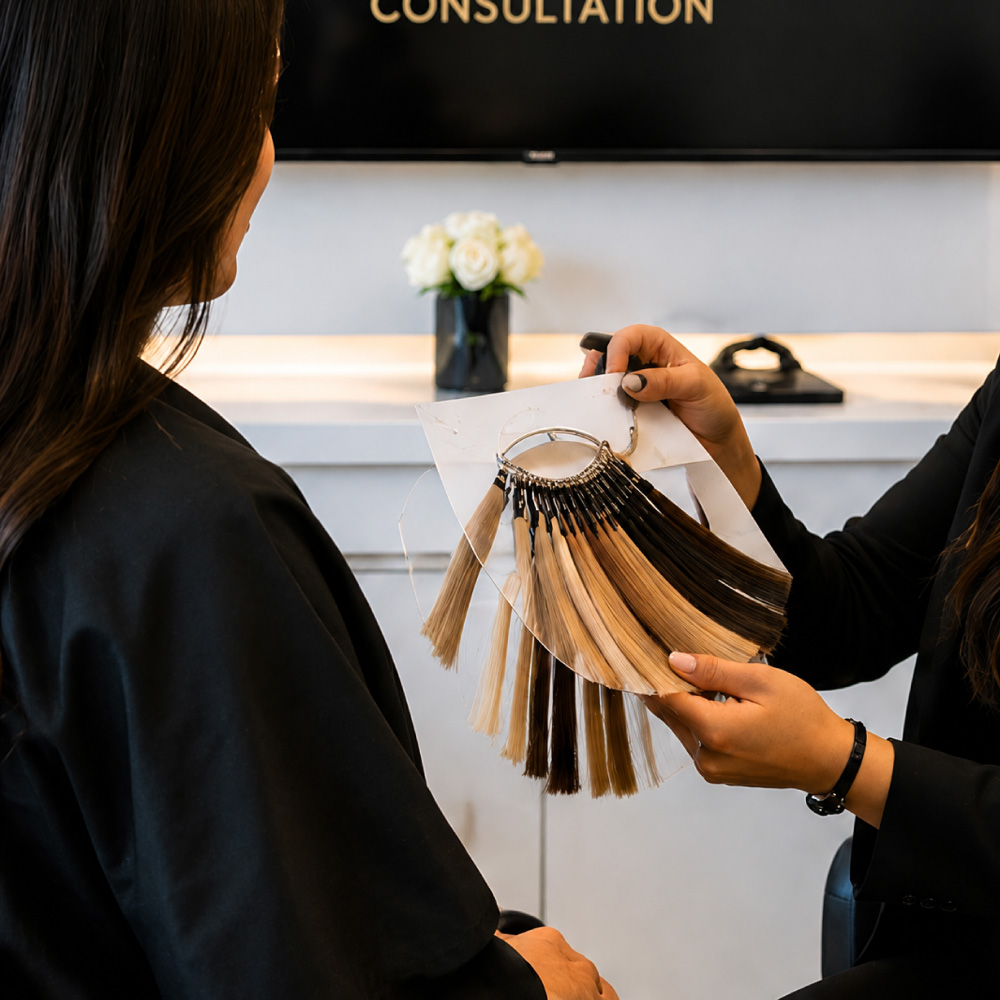
The Avissa Nano Bead Consultation
A responsible extension plan begins before any hair is ordered. During the consultation, we evaluate:
| • | Natural density at the scalp, mids and ends. |
| • | Strand strength, elasticity, breakage and shedding history. |
| • | Scalp condition and any areas of sensitivity. |
| • | Current haircut, shortest layers and target length. |
| • | Hair color in natural light and under indoor lighting. |
| • | Preferred part, ponytail height, braids, upstyles and face-framing habits. |
| • | Exercise, swimming, sauna, travel and wash frequency. |
| • | Time available for installation and maintenance. |
| • | Home-care habits and willingness to use extension-safe tools and products. |
| • | Previous extension wear, slippage, matting, discomfort or damage. |
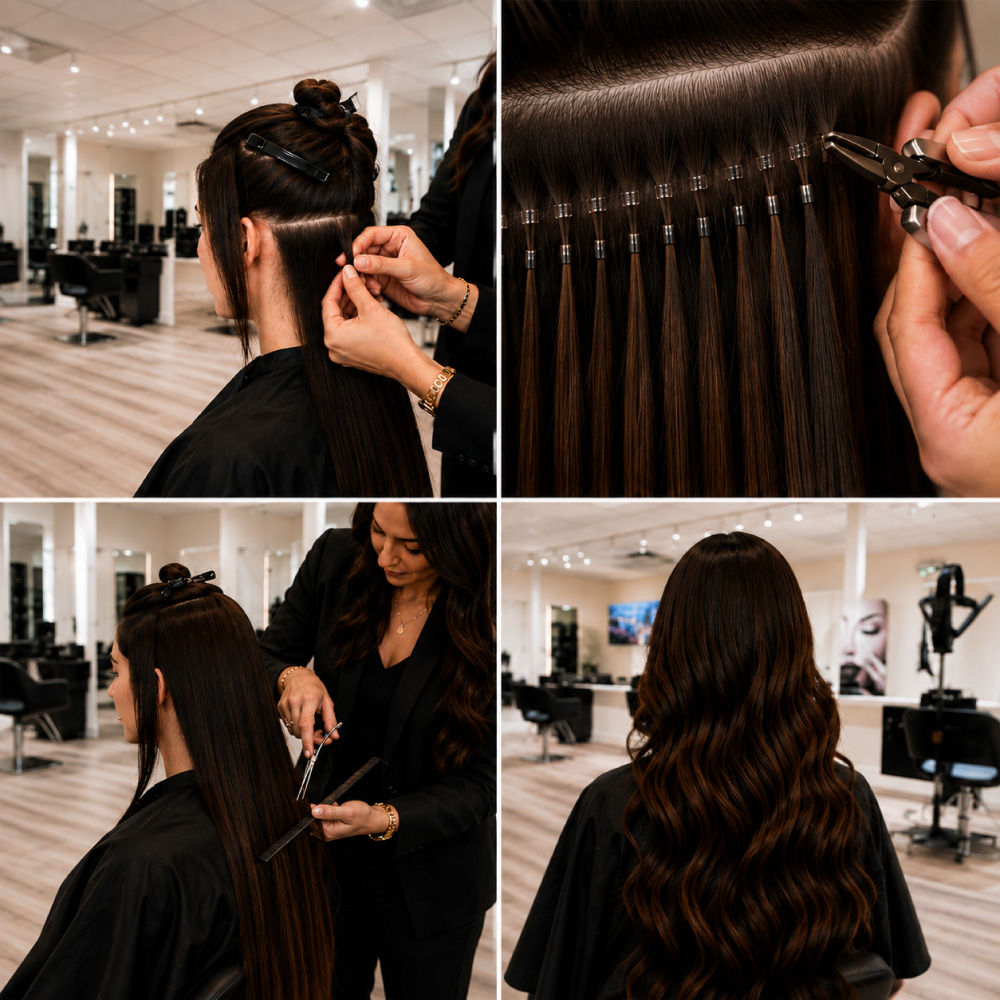
What to Expect During Installation
| 1. | Consultation and final plan: We confirm the target length, density, colors, attachment zones and maintenance expectations. |
| 2. | Preparation: The hair and scalp must be clean, dry and free from heavy oils or residue around the attachment area. |
| 3. | Sectioning: Precise sections are created according to natural density, head shape, part and styling habits. |
| 4. | Strand placement: Small sections of natural hair are threaded through the selected beads, extension strands are inserted, and each bead is closed with controlled pressure. |
| 5. | Balance check: Density, spacing, direction and concealment are reviewed throughout the installation. |
| 6. | Blending haircut: The natural hair and extension hair are shaped into one silhouette. |
| 7. | Home-care education: We demonstrate brushing, washing, drying, sleeping and product placement before you leave. |
Comfort standard:
A new installation may feel unfamiliar, but it should not produce sharp pain, persistent pulling, headaches, sores or scalp inflammation. Contact the salon promptly if an attachment feels painful or unusually tight.
Maintenance: The Part That Protects the Result
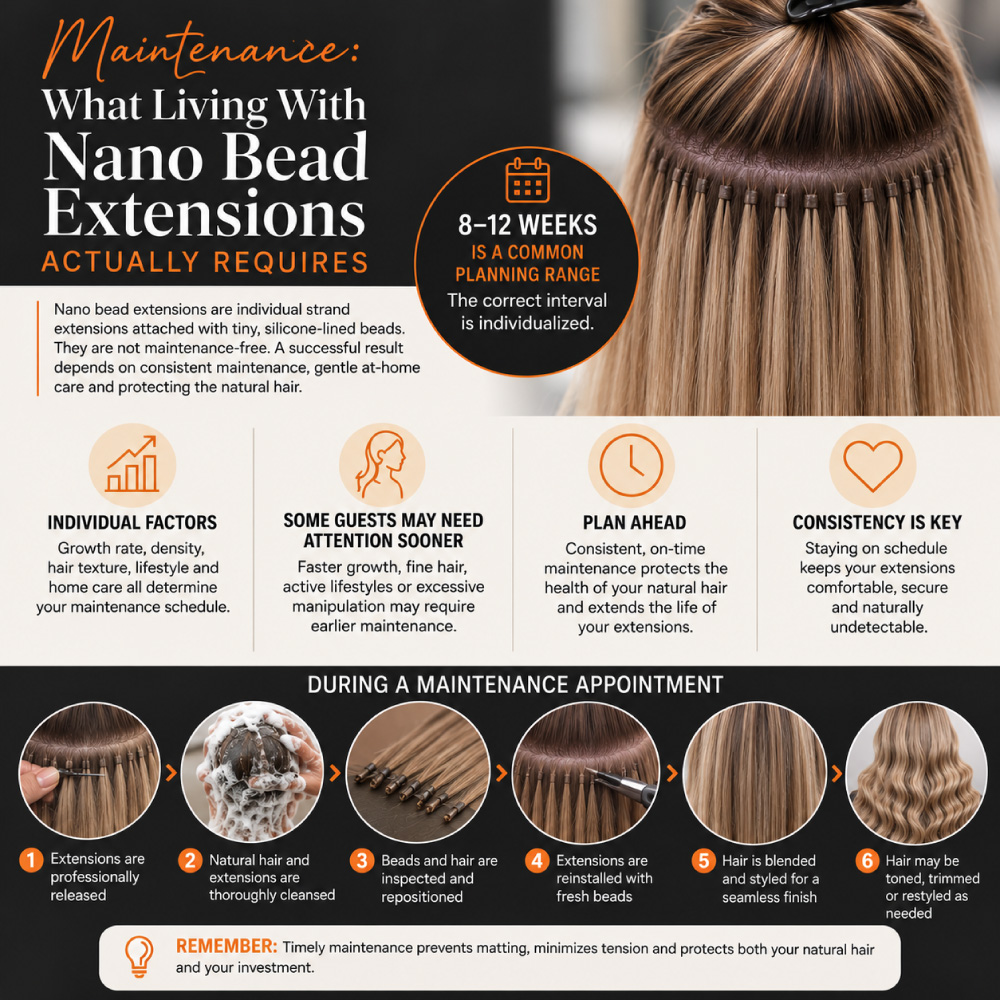
Nano bead extensions are semi-permanent, not maintenance-free. As natural hair grows, each bead moves farther from the scalp. That increases leverage, allows shed hairs to remain trapped near the attachment and creates more space for strands to cross or tangle.
Many guests require maintenance around every six to eight weeks, but there is no universal interval. Growth rate, natural density, strand size, installation design, shedding, product use and home care all affect timing. Follow the schedule provided by your extension specialist rather than waiting until the beads feel loose or the root area becomes tangled.
During maintenance, attachments are evaluated individually. Beads may be opened, repositioned or replaced; shed hair is released; the extension strands are inspected; the scalp and natural hair are assessed; and the installation is rebuilt according to the current density and growth pattern. A responsible maintenance appointment may also involve reducing weight, replacing worn strands or changing placement—not simply moving every piece back up.
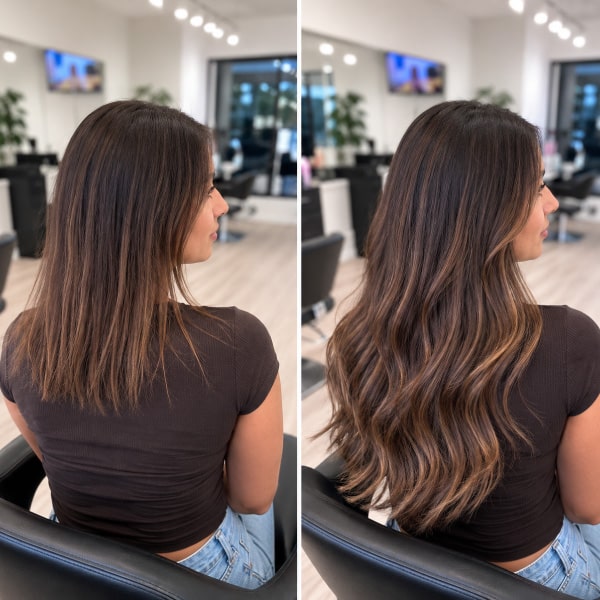
Daily Care for Nano Bead Extensions
| • | Brush gently from the ends upward while supporting the row with your opposite hand. |
| • | Separate the rows and the natural hair around them so neighboring sections do not mat together. |
| • | Apply conditioner, masks and oils through the mid-lengths and ends, not directly on the beads or scalp attachment area. |
| • | Wash the scalp thoroughly without aggressively scrubbing, twisting or piling the hair. |
| • | Dry the scalp and beads completely after washing, exercise or swimming. Going to bed with damp attachments increases tangling risk. |
| • | Use heat protectant and keep hot tools away from the bead and attachment tip. |
| • | Sleep with detangled, fully dry hair secured in a loose braid or low ponytail. |
| • | Avoid picking at, twisting or repeatedly sliding the beads. |
| • | Do not trim, clamp, open or remove the attachments at home. |
| • | Attend maintenance on schedule even when the extensions still look acceptable from the outside. |
Exercise, Swimming and Travel
Nano beads can accommodate an active lifestyle, but sweat, frequent washing, chlorine, saltwater, sunscreen and tight hairstyles increase the care burden. Secure the hair in a loose braid or supported style during exercise, cleanse the scalp as needed and dry the attachment area completely afterward.
Before swimming, detangle the hair and secure it to reduce knotting. Rinse with fresh water after exposure to chlorine or saltwater, wash according to your specialist’s guidance, condition the lengths and dry the roots thoroughly. Avoid rubbing oily sunscreen into the attachment area.
For travel, bring the brush and products recommended for your system. Build maintenance timing around extended trips, weddings or major events rather than allowing the attachments to grow out too far while you are away.
How Long Does the Extension Hair Last?
There are two different timelines: the maintenance interval of the installation and the usable life of the extension hair.
The beads generally need professional repositioning or reinstallation on a recurring schedule as the natural hair grows. The extension strands may be reused through multiple appointments if the hair, tip and overall density remain in good condition. Longevity varies significantly with product quality, heat exposure, washing frequency, chemical processing, swimming, home care and the guest’s desired finish.
No responsible salon should promise that every set will last a fixed number of months. Extension hair is a wearable fiber exposed to daily friction and styling. Replacement should be based on condition, not on how many times it has already been reused.
Signs You Should Contact the Salon Before Your Scheduled Maintenance
| • | Sharp pain, persistent pulling, headaches or tenderness at specific attachments. |
| • | Redness, sores, scabbing, swelling or signs of scalp irritation. |
| • | Several beads slipping in a short period. |
| • | Attachments rotating, hanging unusually low or crossing into neighboring sections. |
| • | Root matting that cannot be gently separated. |
| • | A bead that has opened, flattened incorrectly or developed a rough edge. |
| • | Natural hair appearing broken or significantly thinned around an attachment. |
| • | Sudden or unusual shedding. |
| • | An extension strand that is pulling on only a few natural hairs. |
| • | Do not attempt to tighten, reclamp or remove a problem attachment yourself. Early correction is usually simpler and safer than waiting. |
Nano Beads Are Not “Damage-Free” – No Extension Method Is
“No glue” and “no heat” describe the attachment process; they do not eliminate mechanical stress. Any semi-permanent extension can contribute to damage when the natural hair is overloaded, sections are too small, tension is excessive, maintenance is delayed, home care is poor or removal is improper.
The most important protective decisions are conservative weight, appropriate section size, controlled placement, honest candidacy screening, timely maintenance and professional removal. Guests also need to report discomfort rather than assuming pain is normal.
For some guests, the safest recommendation is a shorter target length, fewer strands, a different method, a temporary extension option or postponing the service until the natural hair and scalp are in better condition.
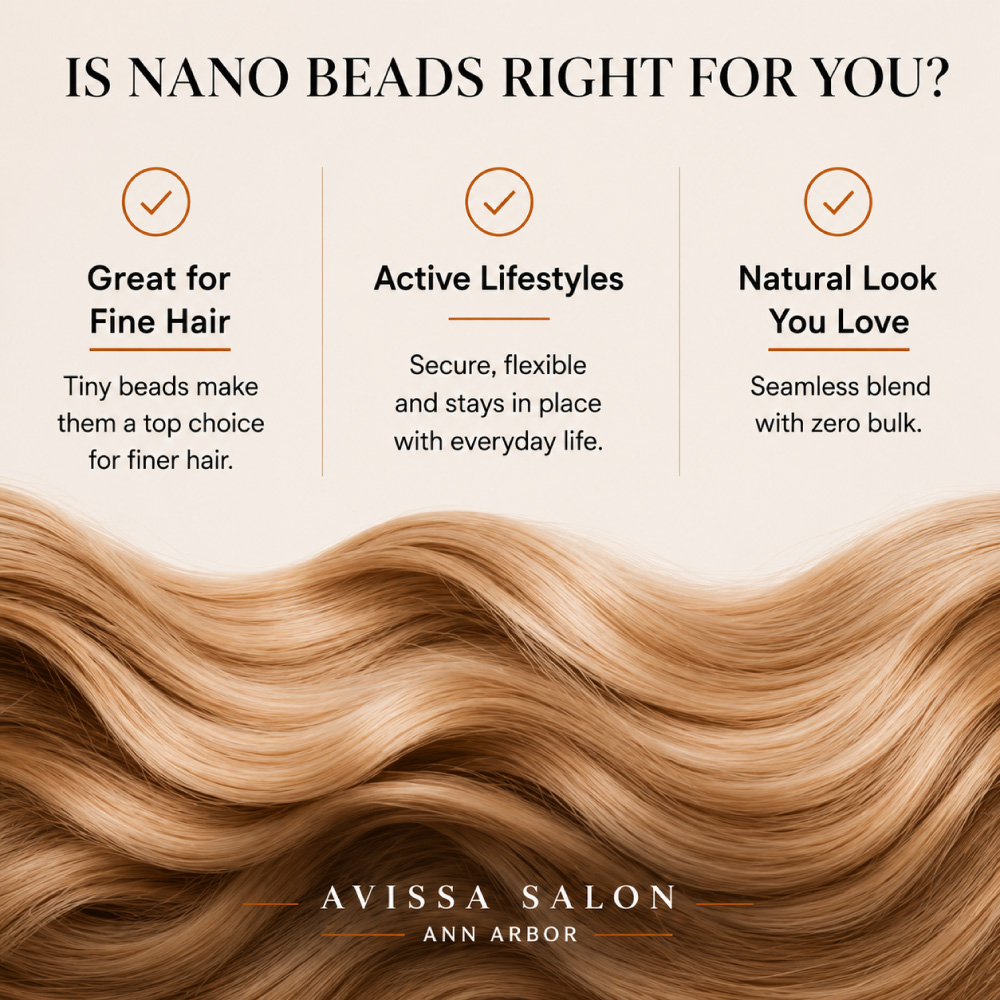
Not Sure Which Hair Extension Method Is Right For You?
Choosing the right hair extension method depends on several factors, including your natural hair density, desired length and volume, lifestyle, styling routine, and maintenance preferences. While each extension system offers beautiful, natural-looking results, some methods are better suited to certain hair types than others.
During your personalized consultation, we’ll evaluate your hair and recommend the option that best supports your goals while protecting the health of your natural hair.
Frequently Asked Questions (Nano Bead Hair Extensions)
Are nano bead extensions the same as micro bead extensions?
They are related individual-strand methods, but the terms are not standardized. Nano systems generally use smaller beads and finer attachment tips than traditional micro-ring systems. Ask which exact product, bead and strand construction will be used.
Do nano bead extensions use glue or heat?
Most nano bead systems secure the extension mechanically inside a small bead and do not use adhesive or bonding heat at the attachment point. Heat tools may still be used for styling, and product design varies by brand.
Will nano beads damage my natural hair?
Any extension method can contribute to damage if the hair is overloaded, tension is excessive, maintenance is delayed or removal is improper. Careful candidacy assessment, conservative weight, controlled placement and professional maintenance reduce risk but cannot make every guest an appropriate candidate.
Are nano beads good for fine hair?
Sometimes. Their small size can provide excellent concealment, but each strand still creates an individual load point. Very fragile, sparse or actively shedding hair may not safely support the desired quantity or length. An in-person assessment is essential.
How often do nano bead extensions need maintenance?
Many guests require service around every six to eight weeks, but growth rate, density, strand size, shedding and home care can change the interval. Follow the personalized schedule provided by your specialist.
Can I wear my hair in a high ponytail?
Often, yes. Individual placement can offer excellent upstyle flexibility when the beads are positioned around your preferred styles and there is enough natural hair to conceal them. Very tight styles can still expose attachments or create repeated stress.
Why are my nano bead extensions slipping?
Possible causes include excessive oil or buildup, very silky hair, incorrect section size, bead wear, product placement, frequent manipulation or an installation issue. A few isolated slips may occur, but repeated slippage should be evaluated.
Can nano bead extension hair be reused?
Often, yes, while the hair and attachment tips remain in suitable condition. Reuse depends on product quality, heat exposure, chemical processing, washing, swimming and home care.
Can nano bead extensions be colored?
Extension hair can sometimes be toned or darkened conservatively, but aggressive lightening can compromise it. The preferred approach is accurate shade selection and coordinated hair color before installation.
Can I swim and work out with nano beads?
Yes, with disciplined care. Secure the hair, rinse after swimming, cleanse the scalp appropriately and dry the bead area completely. Frequent sweat, washing, chlorine, saltwater and sunscreen may increase maintenance needs.
How are nano bead extensions removed?
A professional uses the appropriate tool to reopen each bead and release the extension strand without pulling through the natural hair. Shed hairs and tangles are removed carefully before any reinstallation. Do not attempt removal at home.
How many nano bead strands will I need?
There is no responsible universal number. The plan depends on natural density, target length, haircut, desired fullness, strand weight and the amount of hair each attachment can safely support. More strands are not automatically better.
Why Choose Avissa Salon for Hand-Tied Weft Hair Extensions?
Avissa Salon approaches extensions as a complete design service—not simply the attachment of additional hair.
Our recommendations account for natural density, current haircut, hair color, lifestyle, maintenance tolerance and the result you want to see months from now—not only on installation day. We explain limitations as clearly as benefits, compare methods honestly and reserve the right to recommend a more conservative plan when that is better for the natural hair.
A successful nano bead extension result should feel intentional from every angle: the rows should be supported and concealed, the color should have dimension, the haircut should connect the natural hair to the added length, and the maintenance plan should fit real life.
Ready to Find Out Whether Nano Beads Are Right for You?
Book a professional hair extension consultation at Avissa Salon in Ann Arbor. We will evaluate your natural hair, discuss your goals and lifestyle, compare extension methods and build a plan focused on believable results, comfort and long-term hair health.
Related Links & Services
Learn more about Hair Extensions and discover additional services that complement your appointment and help you achieve your beauty goals.